
Playtime, Barbie, and Existential Nonconformity
Written by Thammarat Connell
Author’s Note: This is modified version of an essay I wrote for an undergraduate college writing course. I have structured it as a conversation between my ‘everyday self’, Brennan, and my ‘creative self’, Thammarat.
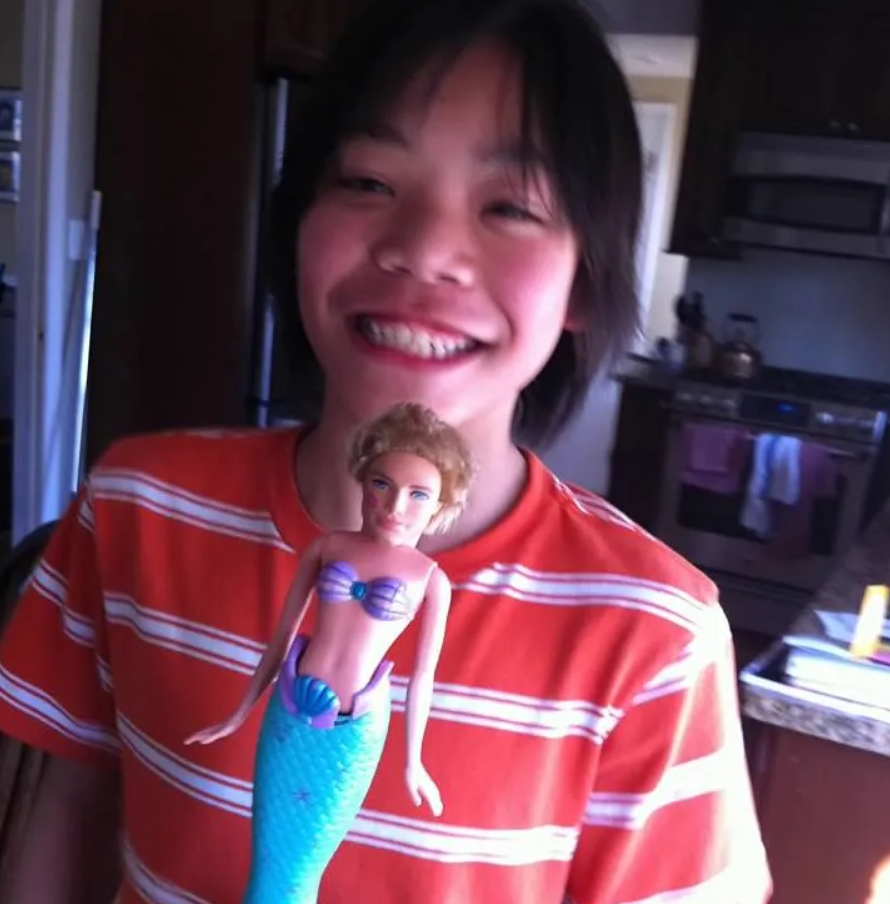
Brennan: The first thing people will probably notice when they read this piece is that photograph above. Can you explain what the image shows, who took it, and why you decided to include it?
Thammarat: The blurred background makes it slightly hard to tell, but that’s me holding an Ariel doll with Ken’s head attached to it! I think I was around 11 years old when my mom took the photo. I don’t recall why I switched Ken and Ariel’s heads, but I do remember doing it quite often with all my dolls, especially my Barbies. I devoted countless hours of my childhood playtime to modifying and reimagining their appearances. These changes were more than just me adding makeup, braiding their hair, or reheading them. These were transformations that, in my head, my Barbie dolls initiated themselves. Even though I knew I was the one physically making the alterations, I loved incorporating those changes into creative adventures centered on my Barbies’ lives. For example, if I decided I wanted a Barbie doll to have shorter hair, I would make up a story where that doll channeled her inner Mulan and chopped her hair off herself. If I drew on my Barbies in marker, that was always accompanied by a story of them tattooing themselves, or doing each other’s makeup, or preparing for a duel. I saw my Barbie dolls as literary beings, and every activity I had them engage in—martial arts, gymnastics, singing, philosophical debates, fashion shows, you name it—was part of a story that I narrated aloud.
I suppose I switched Ariel and Ken’s heads because it fit into some story I was narrating at the time. And I chose to include this particular image because I feel it not only exemplifies the imaginative and exploratory nature of my play, but also because it’s unexpected.
Brennan: Can you elaborate on what was unexpected about your playing?
Thammarat: I think many people who saw my Barbies out of context saw behavior similar to that of Sid from Toy Story. In the movie, Sid is portrayed as a villain because of how he “plays” with his toys. Unlike Andy, who treats his toys with care and kindness, Sid decapitates and mutilates them, switching their heads and bodies. I won’t go into the gender politics of comparing Sid’s way of playing with toys to Andy’s. But I do think the movie reflects how culture and society generally view any violence as antithetical to the notion of play. So, by putting Ken’s head onto Ariel’s body, I was, in a way, evoking that sort of violence. But I was doing it with toys not traditionally associated with boys and in a way that subverted the male gaze, which made it unexpected.
toys not traditionally associated with boys and in a way that subverted the male gaze, which made it unexpected.
Brennan: You say that Barbie is not traditionally thought of as a ‘boy’s toy.’ What first drew you to Barbie dolls? When was the first time you played with them, and what was the experience like?
Thammarat: Barbie as a whole fascinated me as a kid, especially the movies. The stories and songs added a bit of magic and wonder to my life. I found the little messages at the end of each film incredibly profound and inspiring: “There’s a difference only you can make” (Barbie in the 12 Dancing Princesses);” The most beautiful thing you can be is yourself” (Barbie: Mariposa); “Even the smallest person can make a big difference” (Barbie: Thumbelina); “True courage is pursuing your dream, even when everyone else says it’s impossible” (Barbie and The Three Musketeers). Messages like these served as my positive daily affirmations, and I would repeat them to the people around me, whether they wanted to hear them or not. But apart from the movies, the dolls themselves also had a unique place in my heart.
As a child, I was obsessed with glitter, high heels, fashion, and divas, and I associate all of these with Barbie. Her femininity appealed to me, and she was basically my queer awakening. Not in a sexual way, but in how she inspired me to be myself. Similar to how dressing up in costumes influences how a kid expresses and performs gender, playing with Barbie dolls and dressing them up gave me a way to define gender expression and femininity in my own terms.
Brennan: You touched on this briefly already, but could you expand on the different ways people around you (family, friends, relatives, etc.) responded to your playing?
Thammarat: My love of Barbies was hardly a secret to my family. When I first laid eyes on a doll at my friend Bea’s house, I immediately ran over to show it to my parents. I think they were initially confused about why I wanted to play with Barbie dolls, but when they saw how happy Barbie made me—and how she sparked my creativity—they went and bought me a whole bunch of them.
My parents did at first have to explain to my relatives why there were a bunch of barely clothed Barbies with mismatched heads, bad haircuts, and wild tattoos scattered around my room. But once my relatives accepted it, I witnessed their attitudes shift from confusion to unconditional love and support, not just for me but for others, too.
However, encompassing or supporting those who exist in opposition to heteronormative and cultural expectations inevitably creates conflict. There were very few spaces outside my home where I could bravely play with my Barbies. I happened to go to a Waldorf school, but the one time I brought my Barbie to class, the school called my parents (on the very valid grounds that it was not wise to let me carry around a nearly naked Barbie in public).
I also know that challenging expectations can change people’s mindsets. I asked my mom about all this recently, and she told me she had never thought about Barbie as anything other than a problematic toy until she witnessed the “joyful chaos” I made. “Your Barbies were badass warriors who wore DIY clothes, sang amazing songs, and practiced martial arts. It was absolutely beautiful.”
Brennan: You mentioned the beauty and risk of challenging heteronormative and cultural expectations, and I’m curious to know why you think your way of playing with Barbies was so unique.
Thammarat: I think it is critical to establish a distinction between something unique and something unusual. The word unusual generally implies something unexpected but not wholly limited to one person’s experience; however, the word unique implies something both unexpected and entirely intrinsic for a particular individual. So, while my manner of playing with Barbies could definitely be considered unusual, it was by no means unique. Let us not forget that queer girls also play with Barbie dolls, as do others on the LGBTQIA+ spectrum.
But, case in point, you are correct that my way of playing with Barbies did challenge heteronormative expectations and perhaps defied what some might consider “traditional play.” And in many ways, I take great pride in this fact. I think that when we begin to challenge the gendered implications and language surrounding what constitutes “appropriate” playtime behavior, we begin to see a certain type of uniqueness: we cannot truly anticipate how any child will interact with the world around them. Nor can we know what changes might arise from witnessing a child’s imagination at play. Consider, for example, the radical possibilities that occur when any male-identifying person is given a non-judgmental space to play with Barbie dolls. Even though playing with Barbie might not have been “normal,” it helped me normalize being gay and gender expansive as a child.
Brennan: What do you hope people might take away from this dialogue?
Thammarat: When I search up what people have to say about Barbie on the internet, there is basically nothing that resembles my experience, or the experiences of anyone who does not conform to heteronormative expectations. If the conversation only centers around a heterocentric experience, then the experiences of all those children and adults who play with Barbies differently or who are not straight are excluded. My heart is lifted when I see people like Harry Styles transform into a bearded merman for “Music for a Sushi Restaurant,” because it pushes culture towards normalizing gender-expansive behavior. Still, I hope that, by sharing my experiences and thoughts, I can help even more people feel seen and heard. And perhaps I can offer culture an alternative, non-heteronormative way of talking and thinking about Barbie in the process.
We thank Thammarat for sharing their work with us on Groundswell!
Thammarat (pronounced TAH-mah-raht), aka Brennan Connell, is a Maryland/DC–based indie pop songwriter and vocal powerhouse creating story-driven anthems and ballads. Shaped by childhood influences ranging from early-2000s Barbie movie soundtracks and Broadway musicals to LGBTQ+ romance novels, their confessional lyricism, cinematic world-building, and majestic vocals come together in what they call “gaysian theater pop”—music where humanity and queerness take center stage.
See Thammarat’s Socials, Music and Other Works:

Made by a human being—no AI was used in the creation of this work.
